Loss of range of motion (ROM) after acute injury is very common primarily due to swelling and pain. And it usually returns back to normal when inflammation is relieved. For instance, an athlete with acute ankle sprain may display swelling and loss of immediate ROM and it will be to where it was before injury when swelling and pain are gone. However, loss of ROM due to chronic conditions such as frozen shoulder may be more difficult to relieve. One of the reason is that it is developed over a long time and there may be some changes in structure and properties of sift tissue.
But some athletes may display loss of ROM and may not have any symptoms. So, it this bad?? It is not necessarily bad if they do not complain any symptoms which may include pain, decreased performance level, stiffness, etc. However, some research has shown that loss of ROM in certain joint may be linked to possible risk of injury. In overhead athletes such as baseball, softball, and tennis, it is very common to have loss of range of shoulder internal rotation in the dominant shoulder. Instead, usually those athletes will have increased shoulder external rotation compared to the other shoulder. Looking at the total ROM from internal to external rotation end range, if one side has more than 15 degrees less motion than the other side, it is called GIRD (glenohumeral internal rotation deficit) and some research has shown that those athletes may be more prone to an shoulder injury.
Overhead athletes and some athletes like gymnasts may also display loss range of elbow extension compared to the other side. Elbow extension in the dominant arm in overhead athletes may be less than that of non-dominant arm. This may be due to joint capsule tightness and/or forearm muscle tightness (pronator-flexor mass) as a result of repetitive use of the elbow, which can be relieved by stretching exercise. At the same time, it could be as result of early stage of OCD, Panner's disease, bone spur in the olecranon (back of the elbow) which could develop from repetitive stress placed in the joint during overhead motion. Some gymnasts may display loss of elbow ROM without any symptoms probably from repetitive weight-bearing, which puts compressive stress on the outside of the elbow, distraction forces on the inside of the elbow, and overloads between olecranon and humerus. Loss of ROM without any symptoms may not mean that they will need an immediate medical attention but it may be something that needs an eye kept on especially loss of motion is significantly less than the other side. When it is symptomatic in young athletes or elbow does not fully extend (extension is less than 0), they should be seen by a health care provider to find out what is causing it and correct it. Symptomatic loss motion likely indicate some type of injury or condition that needs an attention.
Asymptomatic loss ROM is often ignored until it becomes symptomatic. This may not need an immediate attention as long as it is asymptomatic, however, some literature shows that ROM loss in certain joint may be linked to risk of injury. Loss of ROM in young athletes is certainly something that we need to keep an eye on even when it is asymptomatic.

Tuesday, May 3, 2011


Saturday, February 12, 2011
NSAIDs
NSAIDs (non-steroidal anti-inflammatory drugs) are commonly-used pain-reliever and fever-reducer. Ibuprophen (Motrin, Advil) and Naproxen (Aleve) are examples of NSAIDs. They act by inhibiting the actions of cyclooxygenase-1 and -2 (cox-1, cox-2), which inhibits the formation of prostaglandins. However, inhibition of prostaglandin synthesis in stomach increases secretion of gastric acid and reduces mucus secretion. Thus, one of the adverse effects of NSAIDs is stomach irritation or ulcers. Selective cox-2 inhibitors are thought to reduce side-effects on GI (gastrointestinal) tract because only cox-1 produces prostaglandins that protect the stomach. Other side-effects of NSAIDs include prolonged bleeding time, increased risk of myocardial infarction (MI) , altered renal function, etc. Asprin, also an NSAID, is rarely used in a sports medicine setting.
Tuesday, September 14, 2010
UCL Tear
The ulnar collateral ligament in the elbow connects two bones in the arm, distal humerus and proximal ulna. It provides stability to the medial elbow, especially in overhead athletes. There are three portions to the UCL, anterior oblique, transverse, and posterior ligament. AOL (anterior oblique ligament) plays an important role in providing stability especially in the cocking phase of throwing or tennis serving. This means that it will be under a great deal of stress during such motion.
Mechanisms of injury involves valgus stress and traction force from the pronator-flexor mass complex. During baseball pitching, the ligament may be under stress that is close to the maximum torque that it can take. A repetitive stress to the ligament over a period of time may cause a partial or complete tear of the ligament.
In younger athletes, their growth plates are the weak link and more prone to an injury. Growth plate injuries instead of ligament injury are more common in those athletes. Medial epicondylar avulsion fractures can happen instead of UCL tear. The sublime tubercle, where UCL inserts on ulna, can also avulse. In addition to valgus stress to the medial part of the elbow, the lateral side of the joint is under compressive force. This force can also cause an injury to the lateral side such as OCD (osteochondritis dessecans).
Throwing mechanics plays an important role in reducing such stress to the joint. Certain mechanics are known to put more stress. Thus, it becomes important that overhead athletes are taught the right mechanics at the beginning because it is a lot harder to re-learn the right way after learning faulty motion than to learn the correct mechanics from the beginning.
Treatment of these conditions include cessation of any overhead activities including throwing, physical therapy to strengthen rotator cuff muscles especially posterior cuff and forearm musculature if it is pain-free, ice, NSAID's to reduce inflammation in an acute phase, etc. Then, gradual interval throwing program should be initiated. If conservative treatment fails, surgical treatment will be necessary.
Mechanisms of injury involves valgus stress and traction force from the pronator-flexor mass complex. During baseball pitching, the ligament may be under stress that is close to the maximum torque that it can take. A repetitive stress to the ligament over a period of time may cause a partial or complete tear of the ligament.
In younger athletes, their growth plates are the weak link and more prone to an injury. Growth plate injuries instead of ligament injury are more common in those athletes. Medial epicondylar avulsion fractures can happen instead of UCL tear. The sublime tubercle, where UCL inserts on ulna, can also avulse. In addition to valgus stress to the medial part of the elbow, the lateral side of the joint is under compressive force. This force can also cause an injury to the lateral side such as OCD (osteochondritis dessecans).
Throwing mechanics plays an important role in reducing such stress to the joint. Certain mechanics are known to put more stress. Thus, it becomes important that overhead athletes are taught the right mechanics at the beginning because it is a lot harder to re-learn the right way after learning faulty motion than to learn the correct mechanics from the beginning.
Treatment of these conditions include cessation of any overhead activities including throwing, physical therapy to strengthen rotator cuff muscles especially posterior cuff and forearm musculature if it is pain-free, ice, NSAID's to reduce inflammation in an acute phase, etc. Then, gradual interval throwing program should be initiated. If conservative treatment fails, surgical treatment will be necessary.
 |
| MRI image of torn UCL |
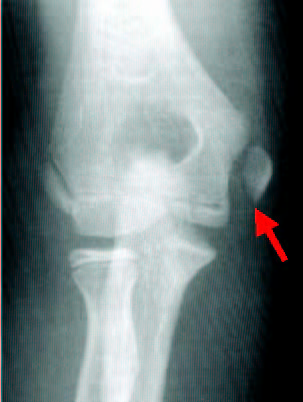 |
| X-ray of medial epicondylar avulsion fracture |
Monday, September 13, 2010
ACL In Preadolescents: Should It Be Reconstructed??
Even though it is still rare, ACL tear in preadolescent athletes are more talked about and diagnosed. A lot more ACL tears in adolescents occur than in preadolescents. However, it is a huge problem to athletes with torn ACL. Whether or not to reconstruct the torn ACL in still controversial.
ACL connects two bone in the knee, femur and tibila, thigh bone and shine bone. It provides stability to the knee and keeps the shine bone from sliding forward on femur and it also prevents excess rotational movements of the knee. Without ACL, athletes will not be likely to perform athletic maneuvers 100% even though there are some who do.
In the preadolescent, their growth plates (physes) are open and still growing. Some doctors are not willing to operate in those athletes. They usually wait until a growth spur occurs to reconstruct the torn ACL. Because there are some reports that growth arrest or other complications may happen if they put a hole through growth plates. There are also reports that say that it is ok to put a hole through growth plates unless a hardware is left in the middle of them.
There are a few methods to reconstruct ACL without drilling a hope in growth plates. One is to put a graft between epiphyes. Each end of the graft will not reach the growth plate and stopped before. Another way is to take an IT band and use is as a graft. Many orthopedic surgeons will wait until growth spur is finished to reconstruct the torn ACL. One problem that may occur is that leaving a torn ACL in the knee will likely lead to degenerative damage in the knee, thus, leading to premature OA (osteoarthritis). Think about 20 some year old female suffering from OA?! That is not easy.
In the end, there is no perfect answer to this question, I believe. There are pros and cons either way, early reconstruction or delayed reconstruction. They all should be discussed by the doctor and family member including the injured athlete herself/himself.

ACL connects two bone in the knee, femur and tibila, thigh bone and shine bone. It provides stability to the knee and keeps the shine bone from sliding forward on femur and it also prevents excess rotational movements of the knee. Without ACL, athletes will not be likely to perform athletic maneuvers 100% even though there are some who do.
In the preadolescent, their growth plates (physes) are open and still growing. Some doctors are not willing to operate in those athletes. They usually wait until a growth spur occurs to reconstruct the torn ACL. Because there are some reports that growth arrest or other complications may happen if they put a hole through growth plates. There are also reports that say that it is ok to put a hole through growth plates unless a hardware is left in the middle of them.
There are a few methods to reconstruct ACL without drilling a hope in growth plates. One is to put a graft between epiphyes. Each end of the graft will not reach the growth plate and stopped before. Another way is to take an IT band and use is as a graft. Many orthopedic surgeons will wait until growth spur is finished to reconstruct the torn ACL. One problem that may occur is that leaving a torn ACL in the knee will likely lead to degenerative damage in the knee, thus, leading to premature OA (osteoarthritis). Think about 20 some year old female suffering from OA?! That is not easy.
In the end, there is no perfect answer to this question, I believe. There are pros and cons either way, early reconstruction or delayed reconstruction. They all should be discussed by the doctor and family member including the injured athlete herself/himself.

Saturday, November 28, 2009
Figure Skating Injury: Medial Malleolar Bursitis
Medial malleolar bursitis is one of the injuries unique to figure skaters, who wear rigid type boots when on ice. This condition happens from repetitive compression, friction, and shear forces created between the malleolus and boot. Common symptoms include pain right over the medial mellaolus which is a bony prominence right above the ankle, swelling, loss of motion, inability to keep a boot on, etc. This can be treated with (relative) rest, activity modification, NSAID's, ice, etc. If symtoms do not resolve with these treatments for a prolonged period of time, a surgical resection of inflamed bursa may be necessary.
In case of septic bursitis, it should be removed surgically immediately and the athlete should be treated with antibiotics.
This injury may be prevented by wearing properly fitted boots, not wearing worn out boots, using extra padding, avoiding overtraining, etc., and early intervention may keep it from progressing. Figur skaters spend hours and hours on ice for training and are prone to overuse injuries. Recognizing early signs and symptoms of any injury and treating them early become a key to prevent furthur injuries and to keep it from getting worse.

MRI image of medial melleolus bursitis.
Sunday, October 11, 2009
ACL Tear Or Not (Differential Diagnosis)
ACL tears can sometimes be confused with other injuries, especailly when it happens to a younger athletes. Even though increased number of ACL injuries in younger athletes are seen, it is still rare compared to older population. Since, in those younger athletes, the weak link is their growth plate instead of the ligament itself, an injury to open growth plate (physis) becomes more common. The ligament can pull a piece of bone off of tibial plateau, which can happen by the same mechanisms of injury as an ACL tear. This can be detected by plain films. This injury is also different from ACL tears in that this can be repaired surgicaly not having to have it reconstructed.
Another injury that can be confused with ACL tears is petalla subluxation. This is due to similarities of both injuries. They both happen from similiar mechanisms of injury. Clinical presentations are similiar, such as immediate swelling, loss of motion, etc. Another reason for this is that medical professionals have to a tendency to think "knee injury = ligament injury?!" Those medical professionals need to do a thourough evaluation of the injury to avoid misdiagnosis.
A key to a quick recovery from an injury that has happended is to find out what the injury is and have it taken care of early and appropriately.
![]()
With patellar subluxation, the patella (knee cap) dislocates and it goes back in place by itself. So, there is no need for reduction. It may need to be immobilized, however. Most of the times, the patella dislocates/subluxes lateraly.
Another injury that can be confused with ACL tears is petalla subluxation. This is due to similarities of both injuries. They both happen from similiar mechanisms of injury. Clinical presentations are similiar, such as immediate swelling, loss of motion, etc. Another reason for this is that medical professionals have to a tendency to think "knee injury = ligament injury?!" Those medical professionals need to do a thourough evaluation of the injury to avoid misdiagnosis.
A key to a quick recovery from an injury that has happended is to find out what the injury is and have it taken care of early and appropriately.

With patellar subluxation, the patella (knee cap) dislocates and it goes back in place by itself. So, there is no need for reduction. It may need to be immobilized, however. Most of the times, the patella dislocates/subluxes lateraly.
Thursday, October 8, 2009
When To Wait, When Not To.
Sometimes, unfortunately, injuries do happen. Injuries like ACL tears usually require surgery. However, it is not easy to make a decision and have a surgical procedure done, psychologically and timing-wise. Sometimes, it is wise to have it done right away. Sometimes, the athlete can wait. This decision making should be done considering the severity of the injury, recovery time, etc.
Rehab after ACL reconstruction takes about 5-6 months. This means, for some sports, the end of a season. Let's say the injured athlete is a professional baseball player and gets injured during spring training. This means that he will be more than likey miss the entire season. And his goal will become returning to the field the next season. If he gets surgery done by June, he will have enough time to get ready for the following season. However, he has about 3 months to make his mind up. In his case, he has an option to try to rehab his knee until then. If it works, he may be able to play. If not, he can go ahead and get a procedure done.
On the other hand, let's say the injured athlete is a 16 year-old soccer player who plays for a club team and for high school. In this case, her soccer season is pretty much all year around. It will probably better for her to have surgery done sooner because the longer she waits the longer her return to play will be.
Some cases are more complicated than these cases. But final decision should be made by the injured athlete (and parents if the athlete is a minor), not the surgeon or coach.
Rehab after ACL reconstruction takes about 5-6 months. This means, for some sports, the end of a season. Let's say the injured athlete is a professional baseball player and gets injured during spring training. This means that he will be more than likey miss the entire season. And his goal will become returning to the field the next season. If he gets surgery done by June, he will have enough time to get ready for the following season. However, he has about 3 months to make his mind up. In his case, he has an option to try to rehab his knee until then. If it works, he may be able to play. If not, he can go ahead and get a procedure done.
On the other hand, let's say the injured athlete is a 16 year-old soccer player who plays for a club team and for high school. In this case, her soccer season is pretty much all year around. It will probably better for her to have surgery done sooner because the longer she waits the longer her return to play will be.
Some cases are more complicated than these cases. But final decision should be made by the injured athlete (and parents if the athlete is a minor), not the surgeon or coach.
Subscribe to:
Posts (Atom)